25 Anniversary 1/2: ELB archives 1999/2007
Feel free to check out my 2nd post: https://www.artstation.com/artwork/WBokoG
This year I'm celebrating my 25th anniversary as a Game artist.
I had never published my first artworks. During a discussion, my colleague Maxime Goichot brought up the idea.
I thought it would be interesting to take advantage of this anniversary to retrace my journey.
This is something that I happened to do with students sometimes: talk about old generations of consoles, developments in the workflows, etc...
Today's processes no longer have anything in common with the way I worked when I started.
Here is a summary accompanied by period documents.
To make that article, I had to collect old artworks, often with fairly low resolutions, and try to post the most representative screenshots of my work based on the few I had archived.
This first post concerns the studio where I started: ELB (1999-2007).
I will talk about NFS Porsche Unleashed, Arx Fatalis, Asterix XXL 1 & 2 + Asterix At The Olympic Games
I'm happy to share that with you guys! Enjoy :)
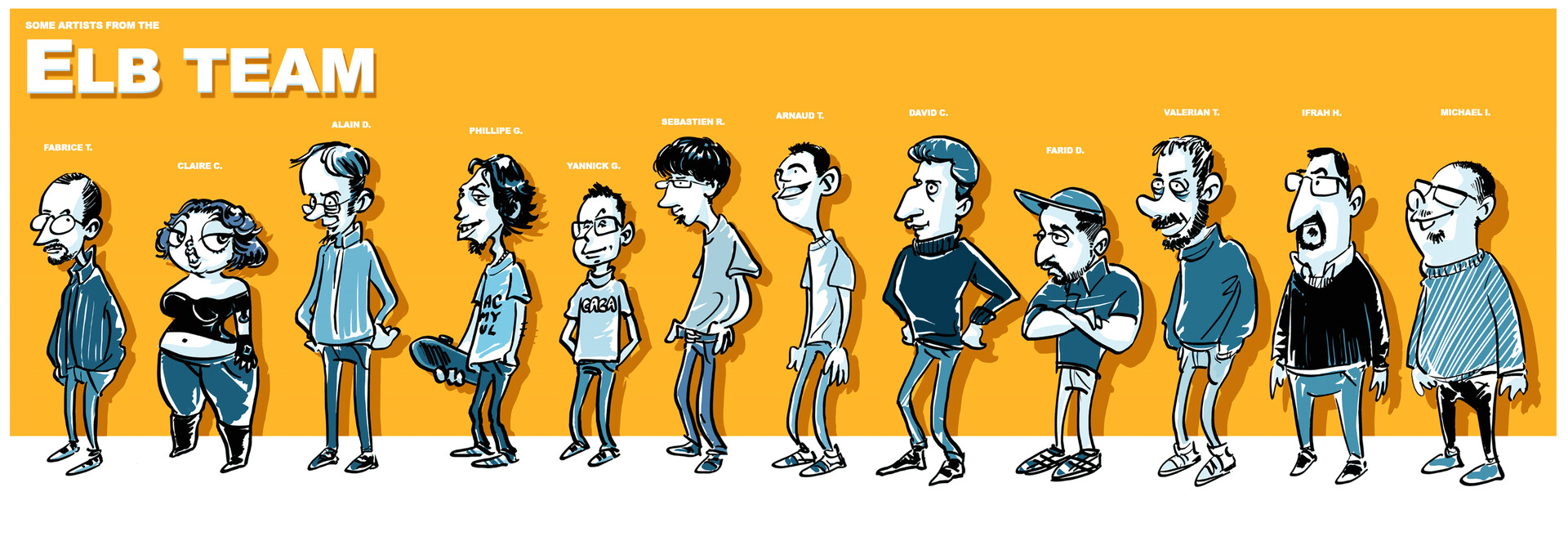
Here are some members of the art team of “Etranges Libellules” (ELB).
I started in the studio in 1999.
I drew these caricatures in 2008.
Some people on this drawing still work with me today: Phillipe Garibaldi, David Cros, Farid Dridi, Michael Intilla.

I was hired at ELB in 1999, without any knowledge of 3D.
I studied in a traditional art school (Emile Cohl). I only mastered Photoshop.
At that time, ELB was mainly outsourcing game art. I started as an environment artist on NFS Porsche Unleashed/PS1.

Working with a low def CRT monitor.
We are on PS1, that means:
-No filtering
-No Tiling (a texture is mapped to a quad)
-0.15 mile road circuit =250 vertices
-assets are sprites
-average texture size: 64x64
-shading=only color maps
-textures=16 colors

In 2000, ELB began outsourcing the environments of Arx Fatalis, the first game from Arkane Studio.
At this time, I met their young team, with great people, such as Raphael Colantonio, Marco Mele, ... and their art director Olivier Enselme-Trichard.

As it was a 100% PC game, the constraints were much nicer than on PS1.
The only rule in terms of modeling: not to exceed 4000 vertices displayed on the screen, which at the time seemed wonderfully generous.

Texturing constraints:
-Still no tiling
-Textures (16 or 256 colors) had to include a line of common pixels to be able fit together.
Sometimes, this line was mirrored on his center and repeated verticaly /horizontaly, to be able to rotate UVs 90°/180°.
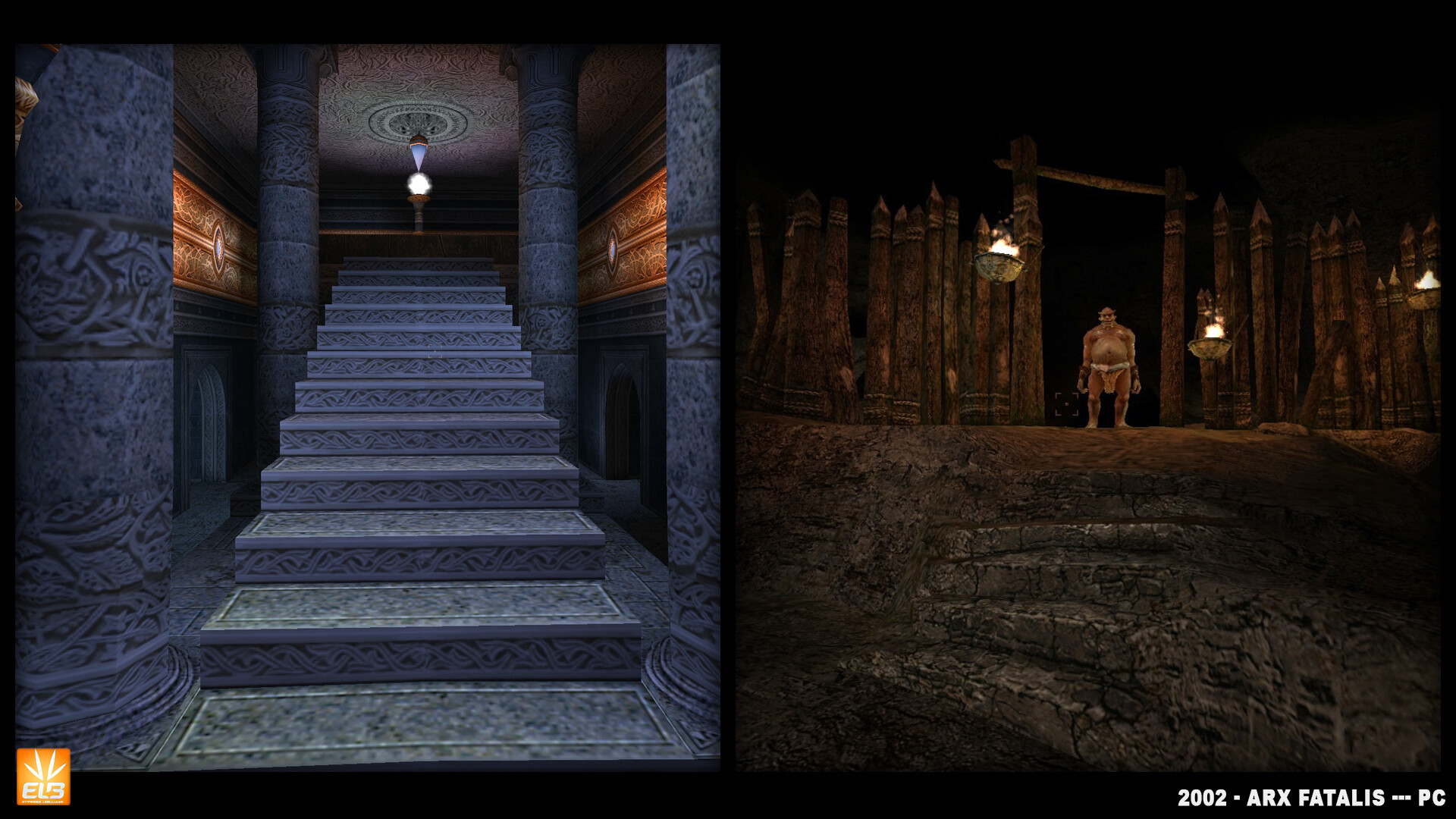
All environments were made by ELB, except human cities (done by Olivier Enselme-Trichard).
We worked in pairs. I have almost always worked with David. He mainly took care of the modeling and I did the texturing, props and polishing.

Here, the temple of Akbaa. I did modeling + texturing on this level.
I also worked on the zone of the dissidents, the troll, the mines, the snake women, the dragon, the dwarves,...

From 2001 to 2003, ELB developped its 1st PS2 game published by Atari: Asterix XXL. I arrived late on XXL production because I was still working on Arx.
I mainly worked on the Normandy level and the village.
Grounds are still made of modular textures sets
XXL was a success. A remaster released in 2020. This footage show the PS2 version emulated with a higher res.
I did that village ground textures set and quickly I hated it. It's uniform, noisy and repetitive. It was my first tiling stylized textures.

The sequel to XXL is a much more accomplished game. It takes place in Caesar's theme park and totally embraces video game parodies.
On XXL2, I worked on entire areas, sometimes in duo with a level artist, sometimes not.

"Le petit Lutéce": supposed to be the Paris area. I worked alone here.
Except the last one, the screenshots are shooted in Maya.
Lighting was handpainted with color vertex. The shadows are splitted on the ground geometry, exept for the foliage (decals).

Props were full handpainted. No highpoly sculpt, no baking.
Lighting is also handpainted (color vertex).
Here you can appreciate textures at their exact real size.
PS2 textures:
-Displaying UVs, using tiling
-average size: 128x128
-16/256 colors
The entrance of the park: the begining of the game.
I've made this area: modeling, level art, props, texturing and lighting (color vertex paint)
Here I made some props like the fake trees and almost all the texturing.

XXL took 2 years to be made, XXL 2 a little over a year, and Asterix at the Olympic Games: 6 months or so.
The game is not as ambitious as the previous ones. It's mostly mini games.

I hardly modeled any architectural elements on this opus, but I made props and a lot of textures, especially tilables grounds and walls.

On this Asterix, I've made a lot of retakes/polish/optimisation. Trying to obtain something better visually with less polygons and textures. Here, a before/after. Original model is not my work.
On PS2, it was easy to switch from environment to characters.

Idefix retake. The original model was from the previous game, made by Emeline Mazallon. It needed to be updated to look more detailed.

Model polished. Original work by Sarah Mercier. Red colors are made with color vertex paint.

Polycount must be low on Ps2.
Hard edges or cuts in a UV shell will multiply vertex count.
So, in order to be optimized, a lot of props used UV mirrors everywhere.
To make cylindrical parts, you needed to make only a slice or a quarter and mirror it.

Assets made by other artists. My mission was to polish and optimise them.
The ligting was mostly painted directly in the color map. Reflections were also painted.
Accentuating the lighting in the texture was a good way to improve the look of an asset.

A few months after its PS2 release, the game needed a nextgen version for Xbox 360.
We therefore did the first tests of normal maps on some assets.

We used to paint height maps in Photoshop and converted them with the Nvidia tool.
Later we'll be able to use tools like CrazyBump.
For cost reasons the normal maps of the Xbox version will ultimately be automatically generated in this way.

The cart was my first asset to use a normal map. Normal maps appeared on the PS3/Xbox 360 generation

texture samples in real size